
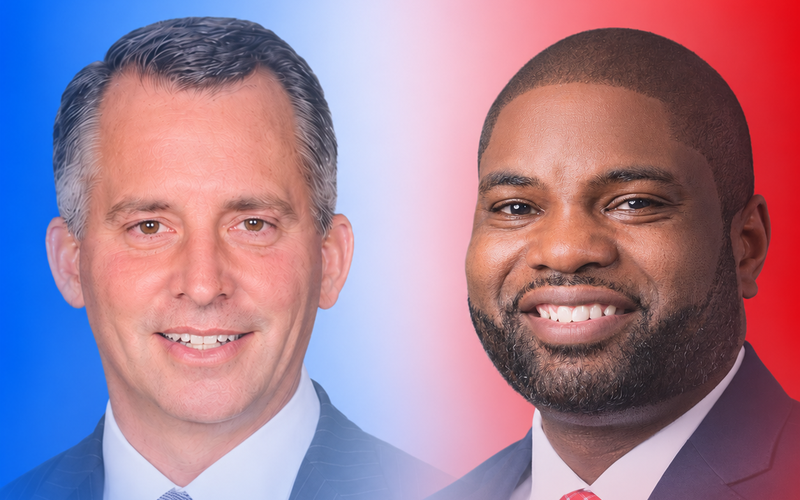
When Ron DeSantis won re-election as Florida Governor by 19.4 points in 2022, it seemed that Florida's status as a "swing state" was a thing of the past. Trump had carried the state in both 2016 and 2020, and now Florida had zero Democrats in statewide elected office. Florida was red through and through.
In 2026, things are different. The consensus from political analysts is that, among early voters, Democrat David Jolly leads Republican Byron Donalds in the race to succeed DeSantis. Republicans hold a roughly two-point edge in terms of turnout, but Jolly is outperforming Donalds among nonpartisans, and he enjoys stronger party loyalty than Donalds does. The result is that Donalds now enters Election Day with a deficit to overcome.
But how strong of an Election Day performance does Donalds need to win? That's the question that we at Victory Insights set out to answer.
We analyzed 5 of the most recent polls of the Florida Governor race, paying special attention to data regarding Republicans' loyalty to Donalds, Democrats' loyalty to Jolly, and how nonpartisan voters were splitting between the two candidates. We built three models: a pessimistic model, for those who feel that the polls were giving Donalds too much credit; an optimistic model, for those who feel that the polls are underestimating Donalds (as they severely underestimated Florida Republicans in the 2022 cycle); and an "average" model, a middle-of-the-road, clear-eyed view of the race grounded in data from all five of the polls we analyzed.
If Florida Republicans don't have strong turnout tomorrow, David Jolly has a genuine shot at winning.@VictoryPolling models show Jolly ahead after early voting, and Republicans needing a strong Election Day to get Byron Donalds across the finish line.
— Ben Galbraith (@_BenGalbraith) November 2, 2026
1/ pic.twitter.com/LP5AkSP8Vm
Election Day turnout, for the purposes of this analysis, has two dimensions: how many people vote, and how strongly Republicans outperform Democrats. Donalds needs strong, Republican-favoring turnout in order to win.
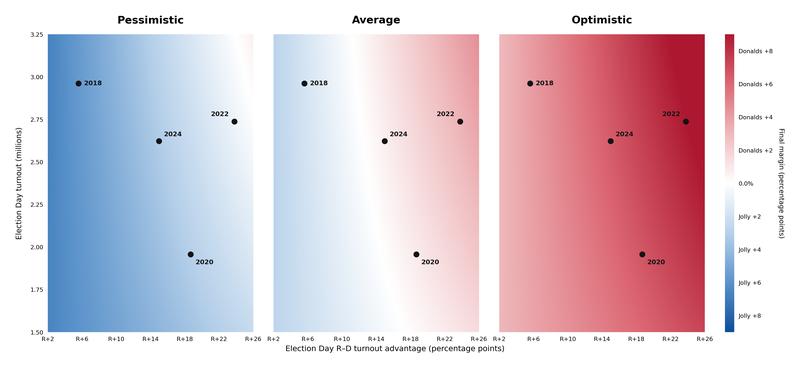
Our pessimistic model found Jolly winning in most Election Day scenarios, and our optimistic model found Donalds winning in all conceivable scenarios, though by varying margins. But our average model is where things get interesting.
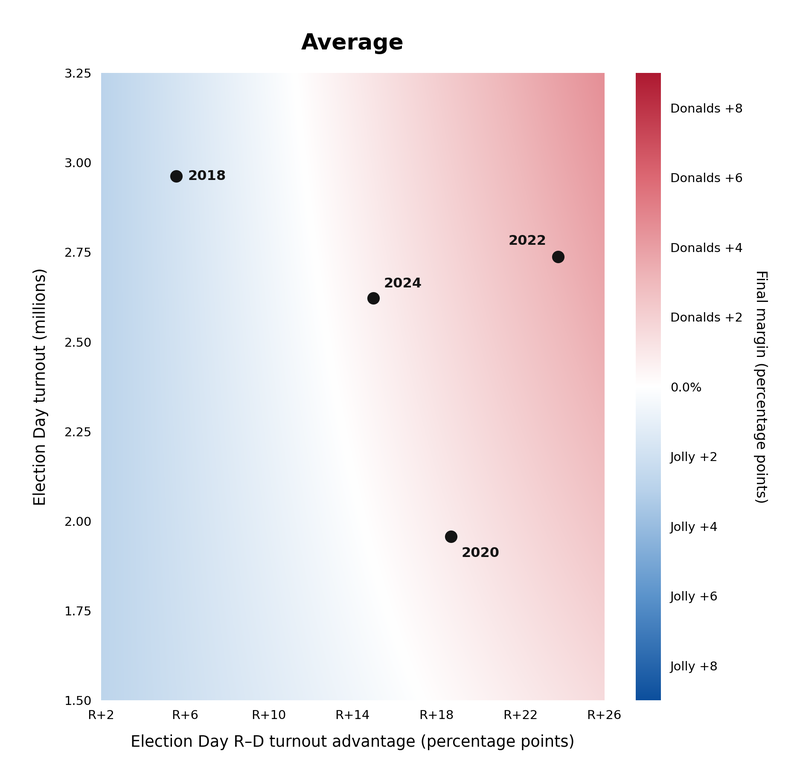
Donalds is expected to win in a high-turnout environment with a strong Republican advantage, while Jolly benefits from low turnout and/or a low-to-mild Republican advantage.
If Florida sees identical Election Day turnout as the 2024 cycle (roughly 2.6 million votes, with an R+15 advantage), Donalds is expected to narrowly escape with a victory, edging out Jolly by less than 1%. If Election Day turnout mimics the 2020 cycle, Donalds is only marginally better off. Even if turnout mirrors Florida's 2022 "Red Wave," Donalds is only favored to win by 3-4 points.
And if Election Day turnout looks anything like 2018 (the last time the nation faced a similar expected "Blue Wave"), Republicans have serious reason for concern. In that scenario, Jolly is the expected winner by a margin of roughly 2 points.
This should serve as a wake-up call to Florida Republicans. Over the past few years, the Sunshine State's Republicans have enjoyed a long string of victories, and they've built a structural registration advantage over Democrats. But this cycle, complacency at the polls could cost them control of the Governor's Mansion.
Despite lackluster early voting numbers and forecasts of heavy rains, Florida Republicans are counting on very strong turnout tomorrow. If that doesn't materialize, the Florida GOP could be in for a rude awakening.

Comments
No comments yet. Be the first to share your thoughts.