
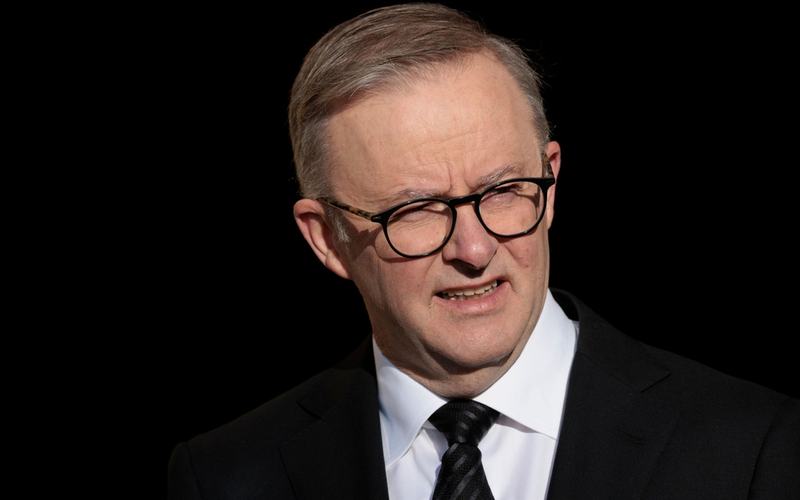
Australian Prime Minister Anthony Albanese warned the United States and China on Thursday that the Indo-Pacific region is not a chessboard for superpowers to maneuver. In a speech accepting the 2026 Atlantic Council Global Citizen Award, Albanese stated that the strategic competition between Washington and Beijing is the most consequential factor shaping the region but cannot serve as the only lens through which to view it.
"The Indo-Pacific is not a chessboard on which superpowers move the pieces," Albanese said. "Its countries are not spectators. They are shaping its future and writing their own script." He added that how Washington and Beijing manage their relationship matters profoundly, while reaffirming Australia's alliance with the United States as the anchor of its foreign policy and its pragmatic engagement with China as its largest trading partner.
Albanese also declared that the post-1945 world order is no longer fit for purpose. He argued that Australia must actively help shape what replaces it by building new partnerships, upholding key rules, and rejecting the idea that might makes right. The remarks came amid the United Nations General Assembly in New York, where Albanese also met with Ukrainian President Volodymyr Zelenskyy to sign a decade-long security agreement committing an additional $60 million in support.
The speech occurred as U.S. President Donald Trump hosted Chinese leader Xi Jinping for the latter's first state visit since 2015. Albanese emphasized resilience in supply chains and critical minerals alongside efficiency, noting lessons from war, disruption, and the pandemic. He highlighted ASEAN centrality and recent upgrades in Australia's partnerships across Southeast Asia as part of efforts to strengthen regional agency.
Australia's position reflects a middle-power approach that prioritizes national interests and sovereignty while maintaining core alliances. Albanese's comments align with similar calls from other leaders for greater input from smaller nations in global affairs rather than passive acceptance of bipolar dynamics.

Comments
No comments yet. Be the first to share your thoughts.