

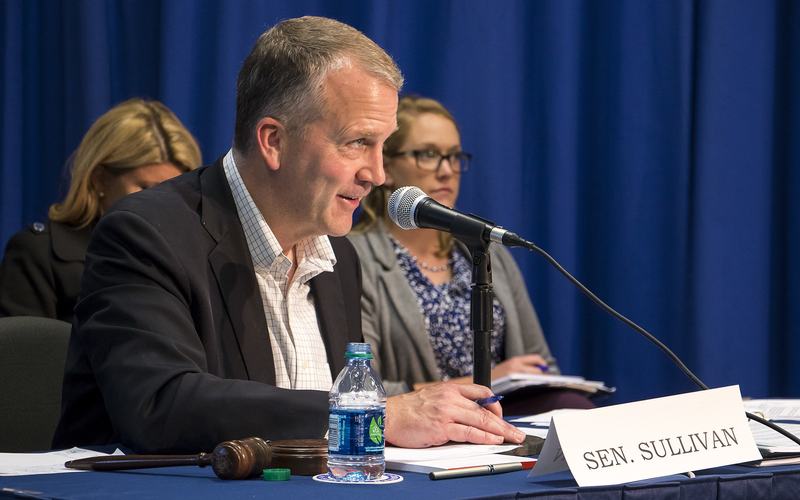
Republican Sen. Dan Sullivan’s reelection campaign and the National Republican Senatorial Committee (NRSC) have established a recount fund as Alaska voters decide a closely watched Senate race that has been complicated by the presence of another candidate named Dan Sullivan.
The fund was disclosed in a Tuesday filing with the Federal Election Commission, according to The Hill. The arrangement gives Sullivan’s campaign and the Senate GOP’s campaign organization a way to prepare financially for a potential recount if the final results require one.
“The NRSC is committed to ensuring every vote is counted fairly and accurately, in each and every state, and we will be ready for all contingencies, including recounts, should they be necessary,” NRSC spokesperson Joanna Rodriguez said.
The preparations come amid controversy surrounding retired teacher Daniel J. Sullivan Jr., whose name appears on the ballot alongside that of the incumbent senator. Both candidates are listed as Republicans, creating the possibility of confusion among voters in a race against former Democratic Rep. Mary Peltola.
The second candidate, retired teacher Daniel J. Sullivan Jr., has been at the center of allegations that Democratic operatives recruited him to enter the race to divert votes from the incumbent. A New York Times investigation reported that individuals connected to Peltola’s campaign and national Democratic political organizations were involved in efforts to recruit the second Sullivan. Peltola has denied that her campaign had any involvement with either Sullivan candidacy. The reported recruitment effort is under investigation by state and federal authorities, but no criminal charges have been announced.
The Trump administration also filed a lawsuit seeking to prevent Alaska from certifying the Senate results if the incumbent lost under circumstances where votes for the second Sullivan could have affected the outcome. U.S. District Judge Sharon Gleason dismissed the lawsuit on November 1, ruling that the Justice Department had not provided a workable way to investigate potentially confused ballots while preserving voter secrecy. The department filed an appeal.
The NRSC’s recount preparations add another layer to the dispute as Alaska conducts its ranked-choice election. The second Sullivan received approximately 2.5% of the vote in the August primary, enough to qualify for the November ballot. Under Alaska’s system, voters can rank multiple candidates, making the final distribution of votes important if no candidate receives a majority of first-choice support.
The recount fund does not mean a recount has been requested or that the results are expected to be challenged. It provides a financial mechanism for addressing recount expenses if the final outcome warrants one. The Federal Election Commission allows campaigns and political committees to establish separate recount funds for that purpose.

Comments
No comments yet. Be the first to share your thoughts.