
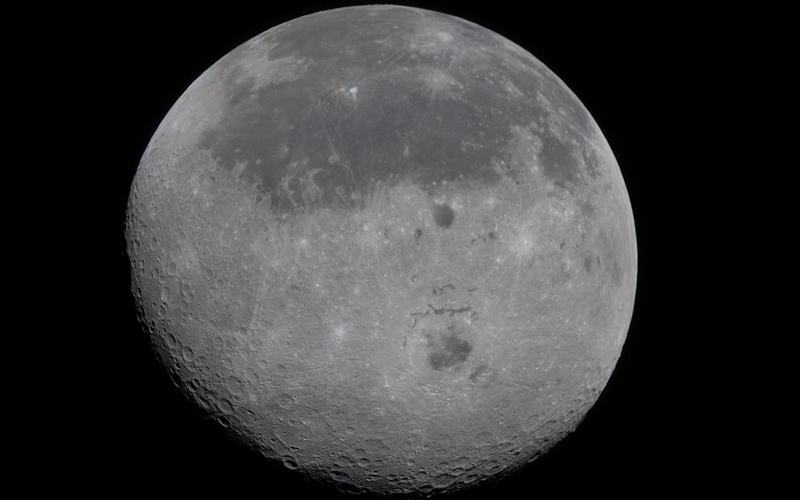
Earth has temporarily gained a second moon after a small asteroid entered the planet's gravitational influence, although astronomers expect the object to leave within the next several months.
The asteroid, designated 2026 QQ8, measures approximately 3 to 6 feet across, making it smaller than most passenger vehicles. Its temporary gravitational relationship with Earth has led astronomers to classify it as a mini-moon, a natural object that becomes temporarily bound to the planet before eventually moving away.
The asteroid reportedly entered Earth's gravitational influence in April 2026 but was not discovered until late August, when Hungarian astronomer Krisztián Sárneczky identified it. Researchers expect its temporary stay to end in late 2026 or early 2027.
During its latest encounter, 2026 QQ8 made a reported closest approach of approximately 333,700 miles from Earth in August. That is farther away than the planet's permanent Moon, which orbits at an average distance of roughly 239,000 miles.
The asteroid is far too small to be seen with the naked eye and cannot be observed through typical amateur telescopes. Astronomers also say it poses no threat to Earth. Even if the space rock eventually entered the atmosphere, its small size would likely cause it to burn up before reaching the surface.
Temporary mini-moons are not entirely unusual. Astronomers have identified similar objects in the past, with some researchers estimating that Earth could have as many as six temporary natural satellites at any given time. Their small size and brief stays make them difficult to detect.
One of the earliest known examples was observed in 1991, and additional discoveries have expanded scientists' understanding of the small objects that can temporarily become gravitationally associated with Earth.
The discovery also follows the identification of another unusual companion, asteroid 2025 PN7, which has reportedly traveled along an orbital path similar to Earth's for decades. Unlike 2026 QQ8, however, 2025 PN7 is classified as a quasi-moon because it orbits the Sun rather than Earth. Scientists estimate that it could remain near Earth's orbital path for several more decades.
While 2026 QQ8's temporary presence will soon come to an end, its discovery provides another example of how small objects can briefly become captured by Earth's gravity before continuing their journey through the solar system.

Comments
No comments yet. Be the first to share your thoughts.