
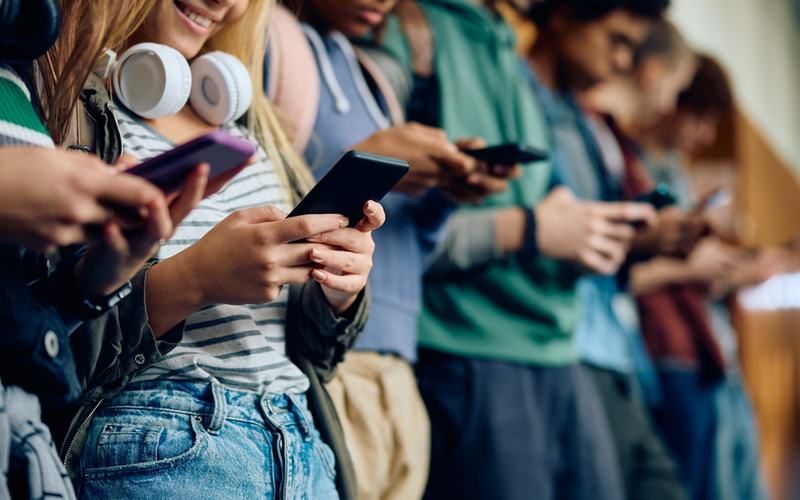
Strict cellphone restrictions in American schools may provide a measurable academic benefit, although researchers caution that removing phones from classrooms alone will not reverse declining student achievement. A new Harvard-led study found that students attending schools with full-day phone bans made modestly greater progress in math and reading than students in comparable schools without strict restrictions.
The study, published Tuesday by Harvard's Center for Education Policy Research, examined standardized test results for approximately 3.3 million students in 4,600 schools nationwide. Researchers focused on grades four through 10 over the past five academic years, comparing schools that required students to store their phones in locked pouches throughout the school day with schools that had less restrictive policies or no bans.
Students in schools with strict restrictions experienced academic improvements equivalent to roughly one or two additional weeks of learning over a school year. Researchers said the gains were relatively small but could become more significant if schools maintain the policies over several years.
Thomas Kane, a Harvard professor and one of the study's authors, said the findings suggest cellphone restrictions can help address some of the distractions interfering with classroom learning.
“Our answer is yes, phone bans do have a positive effect on growth. But it’s not a panacea,” Kane said.
The research comes as cellphone restrictions have expanded across the country. More than 40 states have passed laws limiting student phone use in schools in recent years, although the requirements differ considerably. Many states leave implementation and enforcement decisions to individual school districts, creating inconsistent policies nationwide.
The academic improvements identified by Harvard researchers represent approximately half of the annual decline in test scores recorded since smartphones and social media became widespread around 2013. The study suggested that maintaining strict restrictions could gradually help schools recover some of the lost academic progress.
However, the findings are not universally supported by other research. A separate study published in May by the National Bureau of Economic Research found that strict cellphone bans had almost no overall effect on standardized test scores.
That research examined a different collection of schools and test results, along with GPS phone activity, teacher surveys, and information from Yondr, a major provider of lockable cellphone pouches. Researchers found some modest improvements in high school performance over three years, particularly in mathematics, but questioned whether the results demonstrated a broader academic benefit.
Thomas Dee, a Stanford education economist who helped lead the second study, said the early evidence remains limited.
“The early results from school phone bans are largely disappointing and raise unresolved questions,” Dee said. Although he acknowledged that the Harvard findings could indicate improvements accumulate over time, he cautioned against assuming that small gains recorded over a relatively short period will continue.
Researchers have also raised concerns that restricting phones during school hours does not necessarily eliminate students' access to digital distractions. Students may still use laptops and other school-issued devices to access social media, while some find ways around physical storage requirements.
Jean Twenge, a psychologist at San Diego State University and author of 10 Rules for Raising Kids in a High-Tech World, said some schools struggle to enforce their own restrictions. Students have reportedly used spare phones or even phone-shaped objects to make it appear that they are complying with locked-pouch requirements.
“It happens pretty often that there’s a policy of no phones during the school day, bell-to-bell, and you go into the school and phones are everywhere,” Twenge said.
Twenge also questioned whether schools are adequately addressing distractions from computers and other devices. Even when students cannot access their phones, they may still encounter social media through school laptops or other technology.
The impact of smartphone use outside the classroom remains another major unanswered question. Students who spend hours on social media at night may struggle to concentrate during the school day or retain information while studying. Kane said researchers have not been able to fully examine those effects because social media companies have not provided the necessary user activity data for comparison with academic performance.
“I find it astonishing that social media companies know how much time kids spend on their platforms, but that data has never been linked to student outcomes,” Kane said. “We can’t provide answers until the social media companies share data.”
The competing findings suggest that school cellphone bans can reduce some classroom distractions, but their academic impact may depend on consistent enforcement, students' access to other technology, and their digital habits outside school. Researchers say additional years of data will be needed to determine whether the modest improvements identified so far translate into lasting gains.

Comments
No comments yet. Be the first to share your thoughts.