
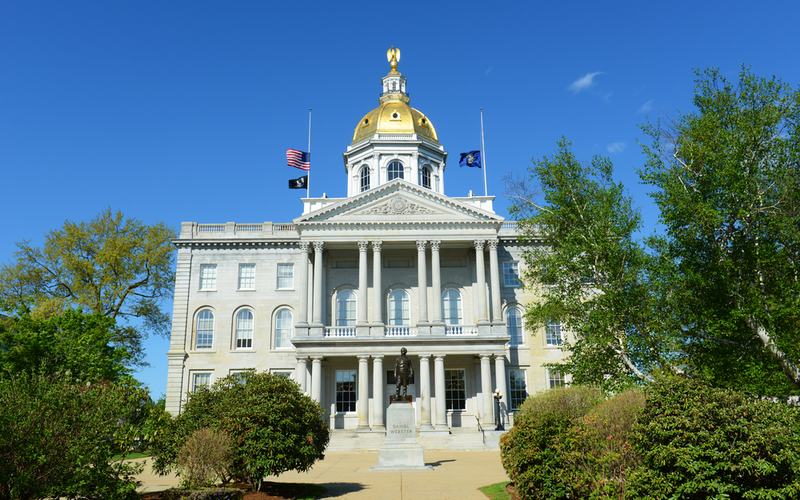
New Hampshire has long defied easy partisan labels. With a large bloc of independent and non-partisan voters, the electorate has a history of splitting their tickets. New Hampshire remains one of the last classic purple states willingly to sending blue congressional delegations to Washington D.C. at the same time as red governors and state legislators go to Concord. Democrats have dominated the Granite State's federal races for years, while Republicans maintained a strong foothold at the state level. After the 2024 elections, that GOP foothold has become something more substantial.
Republicans hold a full trifecta in the state. Republican Kelly Ayotte won the governorship in 2024, succeeding the term-limited Gov. Chris Sununu to continue the record of uninterrupted GOP control of the state's executive since 2017. Republicans expanded their advantages in both chambers of the state legislature, securing a veto-proof supermajority in the 24-member Senate and a clear majority in the 400-member House. These gains came even as Kamala Harris carried the state in the presidential race by roughly three points and Democrats retained both of the state's U.S. House seats and U.S. Senate seats. The state has gone to the Democratic nominee in every presidential contest since 2000, when George W. Bush carried it narrowly.
Under the current trifecta, Republicans have advanced more conservative legislative agendas than many once thought possible. Previous Republicans elected in New Hampshire were unable, or unwilling, to put forward such legislation in fear of political reprisal. The state's electorate still retains a significant politically unaffiliated population that harbor very little interest in extremes. These voters are often the central swing votes that decide close races, moderate Republican leadership long avoided truly high-profile social and cultural issues that chanced the party alienating that support.
Now, a gradual growth in Republican structural power in Concord is notably changing that stance. New Hampshire Republicans have introduced and advanced measures to expand school choice through universal vouchers, restrict gender-affirming care for minors, strengthen voter ID requirements, and broaden Second Amendment protections. Supporters frame these as responses to voter priorities. Critics, including many Democrats in Concord, instead describe the current political environment as more divided since enlarged GOP majorities have reduced the need for bipartisan compromise.
Even with the more conservative efforts, Republicans aren't losing momentum. Ayotte is running for re-election for governor in 2026 and has led early polling by double digits against her Democratic opponent. While the gubernatorial race is considered comfortably red, the New Hampshire U.S. Senate race stands as a key test on whether the GOP's gains can finally translate to a federal contest victory. Former Senator John E. Sununu won the Republican nomination and faces Representative Chris Pappas in the fight for the open seat being vacated by Sen. Jeanne Shaheen. The Cook Political Report recently moved the contest to toss-up status amid close polling and significant Republican spending.
A Republican victory in November would mark the first GOP congressional victory in the state in over a decade. The possibility of a pickup has drawn national attention and millions of dollars flooding the state in support of Sununu, evidence that Republicans see openings in the state even at the federal level. New Hampshire Democrats have already issued warnings to party leaders that the seat is in danger of flipping, Rep. Pappas expressly calling for national Democrats to invest more heavily in the race.
The implications of a Sununu victory would be promising for the GOP as they begin looking towards 2028.
New Hampshire’s four electoral votes are modest, but its first-in-the-nation primary tradition has long given it outsized influence in presidential nomination fights. A sustained Republican infrastructure could provide organizational strength, fundraising networks, and a testing ground for messaging that resonates with a uniquely independent voter base. Demographic and economic factors, including its relative fiscal conservatism and resistance to high taxes, also align more readily with certain GOP priorities.
None of this alone guarantees a Republican presidential win in 2028 or a lasting political realignment. Still, the quiet consolidation of power has certainly changed the baseline. What was once a reliably light blue battleground with a moderate Republican state government has become a place where GOP control is deeper and more consequential. For national Republicans searching for growth beyond red strongholds and traditional battlegrounds, New Hampshire is no longer an afterthought and will be contested seriously if the Democrats' grip on the Granite State falters in 2026.
The question surrounding New Hampshire is not if Republicans can win, but whether Republicans can roll mounting wins and voter support into challenging Democratic dominance at the federal level. New Hampshire voters have all but rejected the modern Republican Party at the federal level since 2016. Every state and local victory has yet to translate to a congressional ballot.
Any 2028 hopes will likely depend on whether state and national Republicans can broaden party appeal beyond fiscal conservatism without alienating the socially moderate-to-liberal independents that have long bucked partisan orthodoxy.

Comments
No comments yet. Be the first to share your thoughts.