
Italy is preparing to increase its naval presence in the Red Sea after Defense Minister Guido Crosetto warned that Europe cannot afford to move slowly while threats to commercial shipping continue to grow.
Italy already contributes to the European Union’s Operation Aspides, a defensive mission established to protect merchant vessels from attacks in the Red Sea. Crosetto said Friday that the operation needs additional warships and ordered the Italian Navy to prepare whatever is necessary to ensure Italian commercial vessels can safely navigate the region.
“After what I said, something moved within Aspides, but we need more ships,” Crosetto said, according to Reuters.
The urgency has increased as Iran-backed Houthi forces have expanded their position along Yemen’s Red Sea coastline. The Houthis have reportedly seized the port city of Mocha and advanced toward Perim Island, which sits near the entrance to the Bab el-Mandeb Strait.
The strait is one of the world's critical maritime chokepoints. At its narrowest point, it is roughly 18 miles wide and connects the Red Sea with the Gulf of Aden. Ships using the Suez Canal to travel between Europe and Asia must pass through the waterway, making any sustained disruption capable of forcing commercial vessels onto longer and more expensive routes.
For Italy, the stakes are particularly high. Roughly 40% of the country's international trade passes through the Suez Canal, according to the Italian shipowners association Assarmatori. Petroleum shipments through the Bab el-Mandeb in June were equivalent to approximately 7% of global oil production, according to Kpler data cited by Reuters.
“When a maritime route is interrupted, goods arrive late, costs increase and prices rise for families and businesses,” Crosetto said.
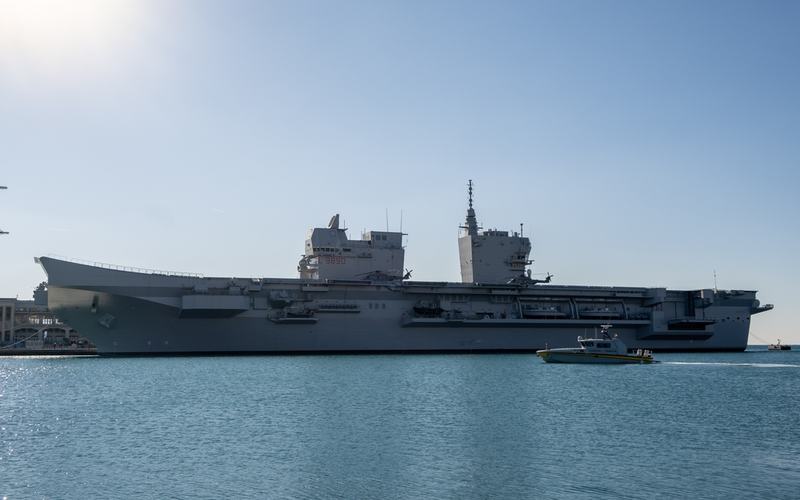
Rome also has substantial naval capabilities available if it decides to expand its role. The Italian Navy operates the aircraft carrier Cavour, which can deploy F-35B fighters, the amphibious assault ship Trieste, Horizon-class air-defense destroyers, submarines and FREMM multi-mission frigates. Italy has previously deployed the Cavour alongside allied naval forces during major NATO exercises.
Italy and Greece currently provide much of the European naval support for maritime security in the region, according to Crosetto, although Rome has not disclosed how many additional ships it could deploy or precisely what the expanded mission would involve.
Italy has already used its forces to protect commercial traffic. The Italian frigate Bergamini escorted a merchant vessel through the Red Sea in August while operating under Operation Aspides.
The EU mission is authorized to accompany merchant vessels, monitor threats and defend ships from attacks at sea. It does not conduct strikes against targets on land. Since launching in February 2024, Aspides has supported more than 2,390 merchant vessels and provided close protection to more than 720 ships as of Aug. 24.
The expanding threat comes as Italy faces economic pressure at home. Consumer prices increased 3.3% year over year in August, while regulated energy prices rose 18.6%. Italy's public debt is expected to reach approximately 138.5% of GDP this year, while the European Commission projects only 0.5% economic growth in 2026.
Another prolonged disruption to the Europe-Asia shipping route could therefore increase transportation, energy and consumer costs at a time when Rome has limited fiscal room to absorb another economic shock.
The Red Sea is also not the only major maritime route facing disruption. Commercial traffic through the Strait of Hormuz remains well below recent averages amid the continuing U.S.-Iran conflict, creating the prospect of simultaneous pressure on two of the world's most important energy and shipping chokepoints.
Italy's decision to prepare additional naval assets reflects the growing concern that protecting commercial shipping may require a larger European military presence rather than relying on a limited defensive deployment.

Comments
No comments yet. Be the first to share your thoughts.