
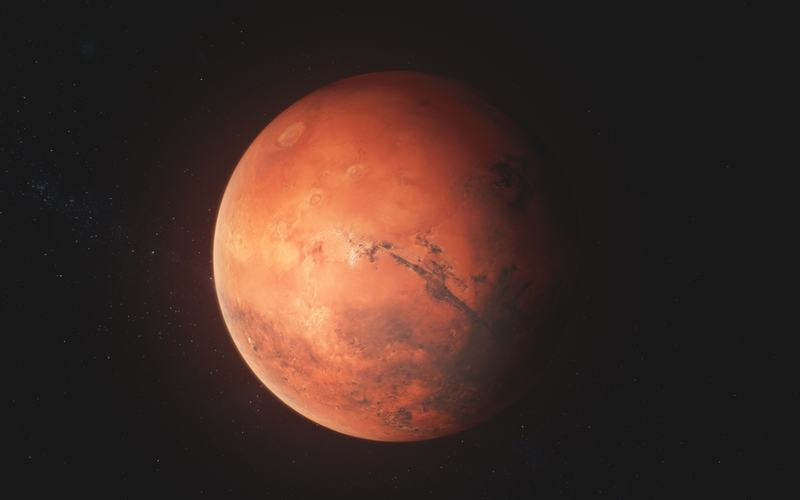
Japan’s space agency is preparing to launch an ambitious mission to Mars’ moons, aiming to collect samples from Phobos and return them to Earth in 2031. The Martian Moons eXploration mission, known as MMX, is scheduled to launch aboard Japan’s H3 rocket on October 19 U.S. time, or October 20 in Japan.
Led by the Japan Aerospace Exploration Agency (JAXA), the mission will investigate Phobos and its smaller sibling, Deimos, two irregularly shaped moons that scientists still know relatively little about. Researchers hope the findings will help answer fundamental questions about how the moons formed and how Mars and the broader Solar System evolved.
One major mystery is whether the moons are asteroids captured by Mars’ gravity or remnants of a massive collision between Mars and another celestial body. Scientists believe analyzing Phobos directly could help resolve the debate and reveal how material moved through the early Solar System.
The mission aims to collect at least 10 grams of material from Phobos using two sampling attempts. Its instruments will gather surface particles and material from beneath the moon’s surface, with the samples sealed in a protective capsule for the journey back to Earth. If the mission proceeds as planned, the capsule will return in 2031.
The spacecraft will also carry a rover called Idefix, developed through cooperation between French and German space agencies. The rover will examine Phobos’ surface and help scientists identify suitable locations for the main spacecraft’s sampling operations. NASA and other international partners are contributing scientific instruments and technical support.
Collecting material from Phobos could offer an additional scientific opportunity. Scientists estimate that a small fraction of its surface material may have originated on Mars itself, blasted into space by impacts over millions or billions of years. Examining those fragments could provide information about the Red Planet without requiring a spacecraft to collect samples directly from its surface.
Researchers also hope the samples will reveal clues about the water and organic materials that helped shape planetary environments and may be relevant to the emergence of life. The mission is not designed to prove that life exists or once existed on Mars, but its findings could improve scientists’ understanding of the conditions that make life possible.
The mission faces considerable technical challenges. Phobos has extremely weak gravity and a heavily cratered surface, making landing and collecting samples difficult. The spacecraft must navigate the terrain, complete its sampling operations, and safely return its cargo across hundreds of millions of kilometers.
If successful, MMX would mark the first time material has been collected from a moon of Mars and brought back to Earth. The results could help scientists better understand the history of Mars, the formation of its moons and the processes that shaped our planetary neighborhood.

Comments
No comments yet. Be the first to share your thoughts.