

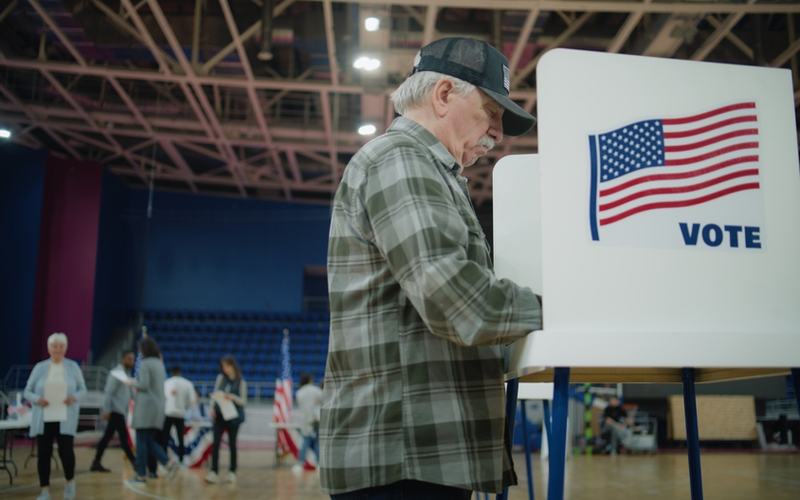
Massachusetts voters rejected Question 3 on Tuesday, declining to replace the state’s traditional partisan primary system with a single “top-two” primary in which candidates of all affiliations compete on one ballot and the top two finishers advance to the general election, regardless of party.
The Associated Press and Decision Desk HQ projected the measure’s defeat early on Wednesday. With a substantial share of the vote counted, the “no” side led by roughly 60 percent to 40 percent. Supporters of the initiative, led by the Coalition for Healthy Democracy, conceded Tuesday night as the results became clearer. The outcome leaves in place Massachusetts’ existing system of separate Democratic and Republican primaries.
Question 3, a citizen-initiated statute, would have applied the top-two format to statewide offices, congressional races, the state Legislature, and certain other contests beginning in 2028. All candidates would appear on a single primary ballot, with party labels retained but no longer controlling nomination. The two candidates receiving the most votes would advance, raising the possibility of two Democrats or two Republicans facing each other in November in a state where Democratic candidates routinely dominate.
Massachusetts has long ranked among the most reliably Democratic states in the country, with the party holding large majorities in the Legislature and controlling the governorship and both U.S. Senate seats for years. Many contests for the state House and Senate are effectively decided in the Democratic primary due to the scarcity of competitive Republican candidates. The most prominent and persistent advocate for the measure was Harvard professor and former 2022 Democratic gubernatorial candidate Danielle Allen. She founded the Coalition for Healthy Democracy, filed the ballot initiative, authored the official “yes” argument in the state voter guide, and served as the public face of the campaign through debates, interviews, and organizing. Allen argued that the change would increase competition in a state with some of the least contested legislative races in the country, give all voters a say in the primary, and force candidates to appeal beyond a narrow party base. “Many elections are over before most of us ever cast a ballot,” she wrote in the voter guide. “More competition means more accountability.”
Former governors Charlie Baker, a Republican, and Deval Patrick, a Democrat, also endorsed the measure, saying it would expand voter choice and encourage broader coalitions. Additional supporters included State Auditor Diana DiZoglio, former MassGOP chair Jennifer Nassour, the NAACP New England Area Conference, and several mayors. The “yes” campaign raised significant funds, including large contributions from private equity.
Opponents, including officials from both major parties, several unions, and groups such as Voter Rights MA, countered that the system could disadvantage independent and third-party candidates, favor well-funded contenders able to dominate a crowded primary field, and reduce the role of parties in selecting nominees. Critics also noted that similar top-two systems in California and Washington have sometimes limited minor-party access to the general-election ballot. The opposition emphasized grassroots organizing and party infrastructure against a well-funded campaign.
The rejection of Question 3, even in a deeply blue state where Democratic primary voters often determine outcomes, preserves the traditional role of partisan primaries. It marks a clear public preference for the existing structure over a nonpartisan, top-two alternative in one of the nation’s most Democratic strongholds.

Comments
No comments yet. Be the first to share your thoughts.