
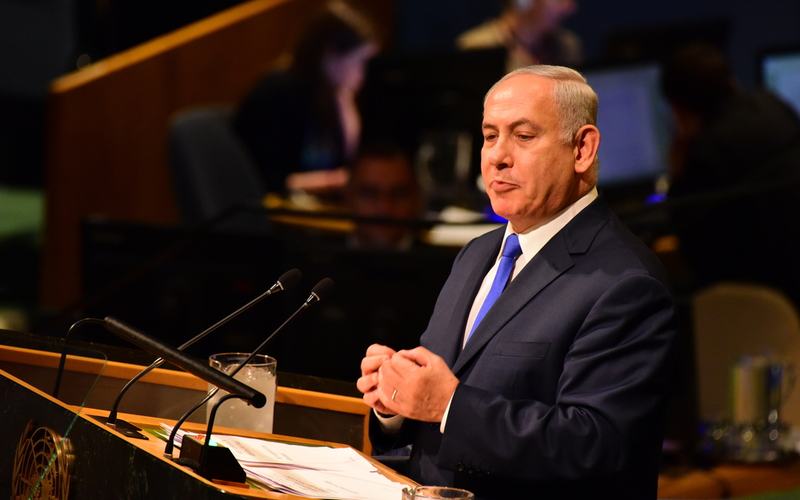
Israeli Prime Minister Benjamin Netanyahu confronted Israel's critics at the U.N. General Assembly Thursday, delivering a defiant speech centered on Israel's right to defend itself against Hamas, Iran and other Iran-backed terrorist groups.
Netanyahu rejected allegations that Israel is committing genocide in Gaza, calling the accusation “the greatest lie of the century.” He argued that Israel's military campaign followed the Oct. 7, 2023, Hamas attack that killed approximately 1,200 people and saw 251 hostages taken. Israel maintains that its military campaign is aimed at Hamas and other armed groups rather than the Palestinian population.
The prime minister also delivered a strong defense of Israel's decision to strike Iran's nuclear program. Netanyahu said attacking Iran was “one of the easiest decisions I’ve ever had to make,” arguing that allowing the Iranian regime to obtain nuclear weapons would have posed an existential threat to Israel and a broader danger to other nations.
Netanyahu thanked President Donald Trump for his support and argued that Israel's military actions against Iran were also protecting countries whose representatives had walked out of the U.N. chamber. He said some foreign leaders had privately thanked Israel for eliminating elements of Iran's nuclear program.
The speech was met with a mass walkout as Netanyahu approached the podium, leaving large sections of the General Assembly Hall empty. Rather than backing away from the confrontation, Netanyahu challenged the departing delegates, calling them “moral cowards” and telling any remaining critics who wanted to leave to do so.
Netanyahu pointed to the scale of the Oct. 7 attack to explain why Israel could not simply return to the status quo that existed before Hamas invaded southern Israel. He compared the Israeli death toll proportionally to the Sept. 11 attacks in the United States, arguing that the assault represented an extraordinary similar national catastrophe for Israel.
He also highlighted Israel's military successes against Iran-backed groups, including Hamas and Hezbollah, and pointed to the 2024 pager operation against Hezbollah as an example of Israel's ability to strike terrorist networks threatening Israeli civilians. Netanyahu argued that these campaigns had weakened organizations that had accumulated large arsenals aimed at Israel.
The prime minister also pushed back against criticism of Israel's conduct in the West Bank, saying he opposes violence by Israeli settlers while accusing international critics and media organizations of exaggerating the scale of the problem. His comments came amid continuing international disputes over Israeli settlements and Palestinian violence in the territory.
Netanyahu separately targeted New York City Mayor Zohran Mamdani, who has called him a war criminal and accused Israel of genocide. Netanyahu accused Mamdani of spreading false claims about Israel and said his rhetoric contributes to hostility toward Israel and Jews.
The address was also notable for its praise of the U.S.-Israel alliance. Netanyahu portrayed Israel and the United States as partners confronting common threats and credited Trump's administration with taking decisive action against Iran. Trump has likewise argued that confronting Iran's nuclear program was necessary to prevent a greater threat to Israel and the wider region.
Netanyahu's speech came as Israel faces intense international criticism over the Gaza war, but the prime minister used the U.N. stage to present a fundamentally different argument: that Israel's military campaigns are defensive actions forced by attacks from Hamas, Hezbollah and Iran, and that weakening those threats serves the security of other nations as well as Israel.

Comments
No comments yet. Be the first to share your thoughts.