
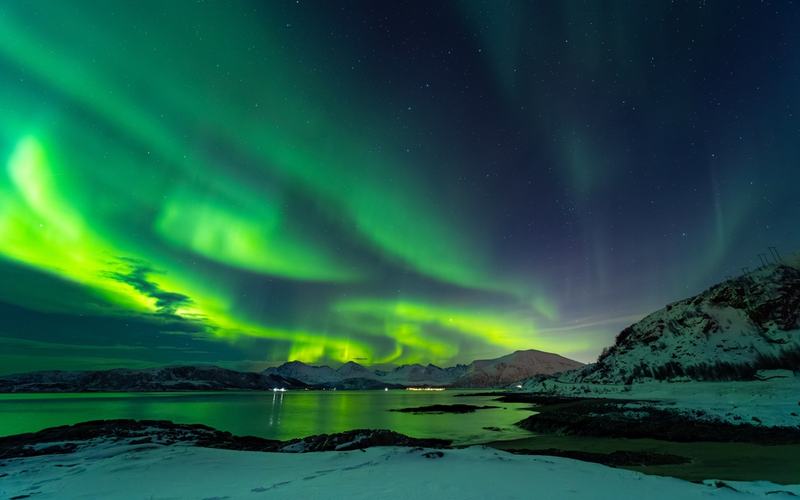
The northern lights could be visible across much of the northern United States Wednesday night as increased solar activity is expected to produce a minor geomagnetic storm, according to the National Oceanic and Atmospheric Administration.
NOAA is forecasting G1-level geomagnetic storm conditions, with the strongest activity expected during the early morning hours of Thursday. A fast stream of solar wind from a coronal hole is expected to interact with Earth’s magnetic field and produce the aurora borealis.
The best chances for viewing are concentrated near the Canadian border. Alaska and portions of Washington, Idaho, Montana, North Dakota, South Dakota, Minnesota, Wisconsin, Michigan, Maine, Vermont and New Hampshire are among the states with the strongest potential for seeing the lights if the forecast develops as expected.
A stronger G2-level geomagnetic storm could expand the aurora farther south, potentially making faint displays visible in states including Oregon, Wyoming, Nebraska, Iowa, Illinois, Indiana, Ohio, Colorado, Pennsylvania and New York. Forecasters caution that the stronger scenario is less certain.
The northern lights occur when charged particles from the sun interact with gases in Earth's atmosphere. Geomagnetic storms can push the auroral oval farther south than its usual range, giving more Americans an opportunity to see the phenomenon.
For the best chance of spotting the aurora, experts recommend getting away from city lights and finding a location with a clear view toward the northern horizon. Higher ground and clear skies can also improve visibility. The display is expected to be most likely from late Wednesday night into the early hours of Thursday.
The forecast remains subject to change because auroras depend on the strength and timing of solar activity. NOAA's latest forecast currently calls for a maximum Kp of 5.33, corresponding to G1 storm conditions, on September 24.

Comments
No comments yet. Be the first to share your thoughts.