
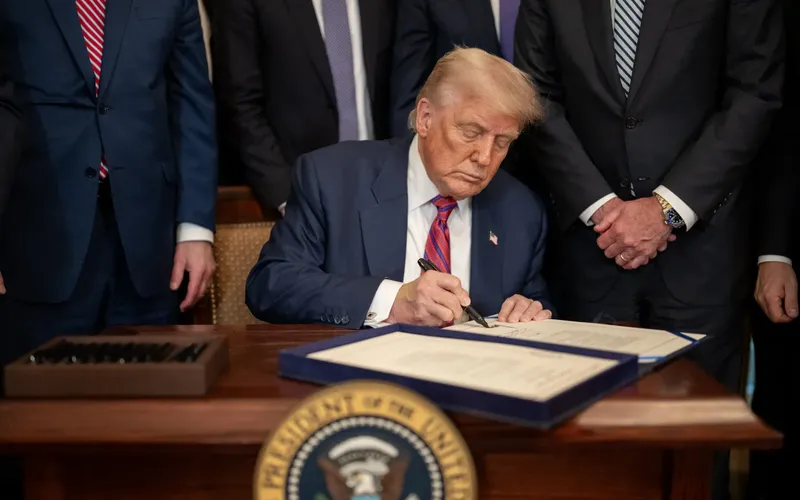
President Donald Trump signed an executive order Thursday designating the Oval Office and the White House Cabinet Room as national landmarks and federal monuments, granting formal recognition to two of the most historically significant spaces in the executive branch.
The Oval Office serves as the president’s primary workplace and one of the most recognizable rooms in American government. Presidents have used it to address the nation, meet with foreign leaders, sign legislation and executive orders, and make major decisions involving national security and domestic policy. Its distinctive design and furnishings have also become closely associated with the American presidency.
The Cabinet Room, located in the West Wing, is where the president meets with members of the Cabinet and senior administration officials. It serves as a central location for discussions involving national policy, government operations, and major international developments. Presidents have used the room to consult advisers during national emergencies and other significant events.
The designations underscore the historical importance of the White House beyond its role as the president’s official residence and workplace. The building has served as the home and office of every U.S. president since John Adams moved into it in 1800, and its rooms have witnessed major decisions throughout the nation's history.
The Oval Office was established in its familiar form during President William Howard Taft’s administration in 1909. It was later rebuilt as part of the West Wing expansion under President Franklin D. Roosevelt in 1934. The Cabinet Room has likewise served successive administrations as a meeting place for presidential advisers and department heads.
Trump has pursued other initiatives involving the preservation and presentation of American history and federal landmarks. His administration has also emphasized traditional architecture in federal buildings, with a 2025 executive order directing the government to favor classical designs for many new federal construction projects and renovations.
The full text of Thursday’s executive order and its specific preservation requirements were not available in the official materials reviewed. The designation nevertheless places two prominent spaces at the center of the White House under formal federal landmark and monument recognition.

Comments
No comments yet. Be the first to share your thoughts.