
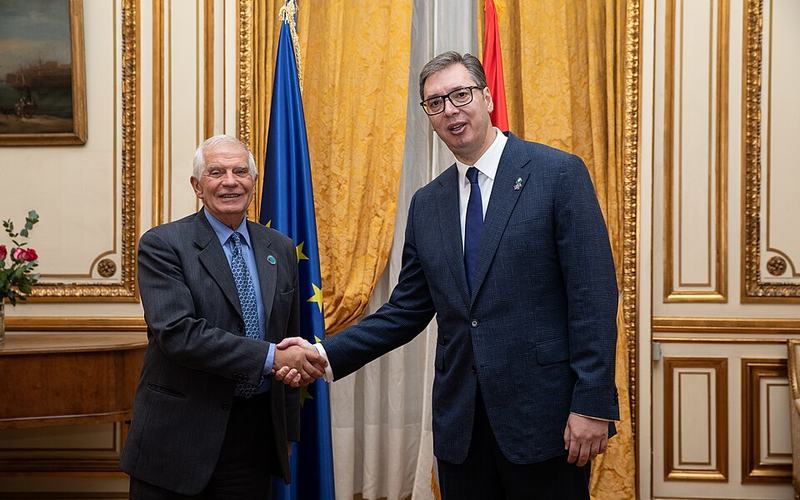
Serbian President Aleksandar Vučić praised President Donald Trump and sharply criticized Western policy toward Kosovo during an address to the United Nations General Assembly on Thursday, presenting Serbia as an independent power willing to maintain relationships with Washington, Beijing and Moscow.
Vučić contrasted Trump with the Clinton administration, which oversaw the 1999 NATO bombing campaign against Yugoslavia during the Kosovo conflict. He said Serbia supports the current U.S. administration and views Trump's leadership as an opportunity for a more balanced international system and a closer relationship between Washington and Belgrade.
“Serbia supports the actions of the administration of President Donald Trump,” Vučić said, describing Serbia as a longstanding American ally.
The Serbian president also expressed hope that Trump's talks with Chinese President Xi Jinping would help stabilize international affairs, using the expected meeting to argue that major powers should maintain dialogue rather than divide the world into rigid political blocs.
Vučić said the post-Cold War international system has effectively collapsed and that smaller countries are increasingly being pressured to choose between competing geopolitical powers. He argued that Serbia should instead maintain its freedom to establish relationships with different countries while continuing its pursuit of European Union membership.
That approach has put the unresolved dispute over Kosovo at the center of Serbia's relationship with the West.
Kosovo declared independence from Serbia in 2008 and is recognized by the United States and much of Europe, but Belgrade continues to reject its sovereignty. Russia and China also do not recognize Kosovo as an independent state.
Vučić argued that Western governments have defended Ukraine's territorial integrity while taking a different approach to Serbia's territorial claims involving Kosovo. He cited U.N. Security Council Resolution 1244, which followed the 1999 conflict and established an international security and civilian presence in Kosovo while reaffirming the territorial integrity of the Federal Republic of Yugoslavia at the time.
He also criticized the lack of progress on a 2013 agreement between Serbia and Kosovo that called for an Association of Serb-majority municipalities. Vučić said Serbia had fulfilled its obligations under the agreement while accusing Kosovo of failing to establish the proposed association.
Despite his criticism of Western policy, Vučić reiterated that Serbia intends to join the European Union. He proposed greater economic integration for the Western Balkans before full membership, including expanded access to the EU single market and the Schengen area.
Vučić ultimately framed Serbia's foreign policy around maintaining independence rather than choosing a single geopolitical camp.
“A world in which we speak only to those who think as we do would have little need for diplomacy,” he said.

Comments
No comments yet. Be the first to share your thoughts.