
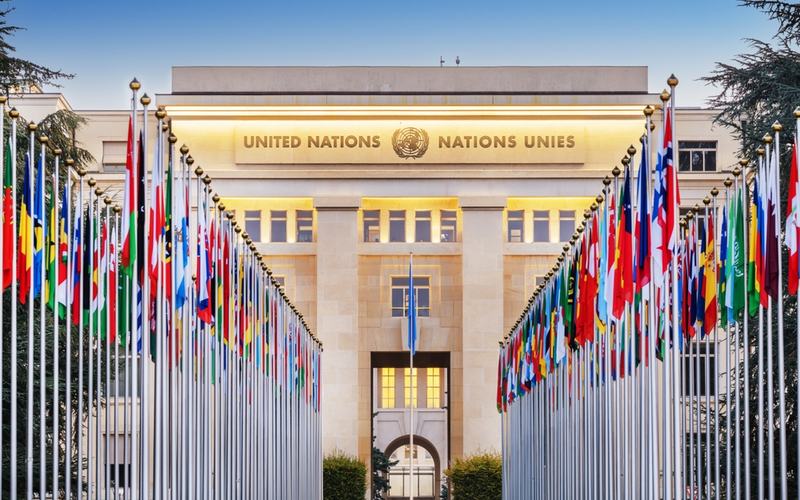
A new study from the Misgav Institute for National Security and Zionist Strategy is challenging the idea that the United Nations’ treatment of Israel can be measured simply by counting hostile resolutions, instead pointing to a network of agencies, committees, investigative bodies and special mandates that the authors say collectively produce disproportionate scrutiny of the Jewish state.
The report, titled “The UN’s Anti-Israel Ecosystem,” was released Wednesday by authors Adi Schwartz and Asher Fredman, with assistance from Noam Yakoby. It examines more than 30 U.N. bodies and mechanisms, including the General Assembly, Human Rights Council, specialized agencies, Secretariat offices and investigative mechanisms.
According to the study, the various institutions can reinforce one another. Political bodies establish mandates and reporting requirements, while other U.N. agencies generate data and reports that are subsequently cited by additional U.N. bodies. The authors argue that this process can cause disputed allegations to acquire the appearance of independent confirmation.
The report cites 187 General Assembly resolutions condemning Israel since 2015, a figure drawn from the UN Watch resolution database. It says that the total is more than twice the number of condemnatory resolutions directed at Russia, China, Iran, Syria, North Korea, Myanmar, Qatar, Pakistan, Cuba and Venezuela combined.
The study also points to the Human Rights Council's Agenda Item 7, which provides a standing country-specific discussion of Israel at every regular council session. It highlights an open-ended Commission of Inquiry and an indefinite Special Rapporteur mandate focused on Israeli conduct, as well as several permanent U.N. institutions dedicated to Palestinian issues.
The Misgav authors argue that Israel has no comparable institutional infrastructure devoted to monitoring the conduct of other parties to the Israeli-Palestinian conflict. They contend that the structure goes beyond political criticism and can contribute to legal initiatives, sanctions proposals, corporate blacklists and other measures affecting Israel.
The report gives particular attention to the period following Hamas' Oct. 7, 2023, attack on Israel. The authors argue that U.N. institutions placed disproportionate emphasis on Israeli conduct while giving insufficient attention to Hamas and other Palestinian armed groups.
UNRWA is one of the most prominent examples examined in the study. The agency has faced allegations concerning Hamas activity among its employees, including an internal investigation into 19 workers accused of possible involvement in the Oct. 7 attack. Investigators found no supporting evidence in one case, insufficient evidence in nine others and evidence suggesting possible involvement in the remaining nine. Those nine employees were terminated.
The broader allegations against UNRWA remain disputed. An independent review led by former French Foreign Minister Catherine Colonna found that the agency had extensive neutrality safeguards but also identified problems involving political activity by employees, some educational materials, and politicized staff unions. The review also said Israel had not provided supporting evidence for its broader claim that significant numbers of UNRWA employees belonged to terrorist organizations.
The Misgav report acknowledges that criticizing the U.N. system does not require arguing that Israel should be exempt from scrutiny. Instead, its authors say the same standards should be applied consistently to Israel and other countries, with investigations based on credible evidence, impartial procedures, and consideration of the conduct of all parties.
The study ultimately makes a broader argument about international institutions: that mechanisms initially created to address Israel specifically can establish legal and political precedents that could later be used against other democratic countries conducting military or counterterrorism operations.
The report's conclusions are those of the Misgav Institute and its authors, rather than an independent finding by the United Nations. Its central contention is that the alleged problem is not simply the number of resolutions targeting Israel, but the network of permanent institutions and procedures through which those resolutions, reports, and investigations are produced and subsequently cited.

Comments
No comments yet. Be the first to share your thoughts.