
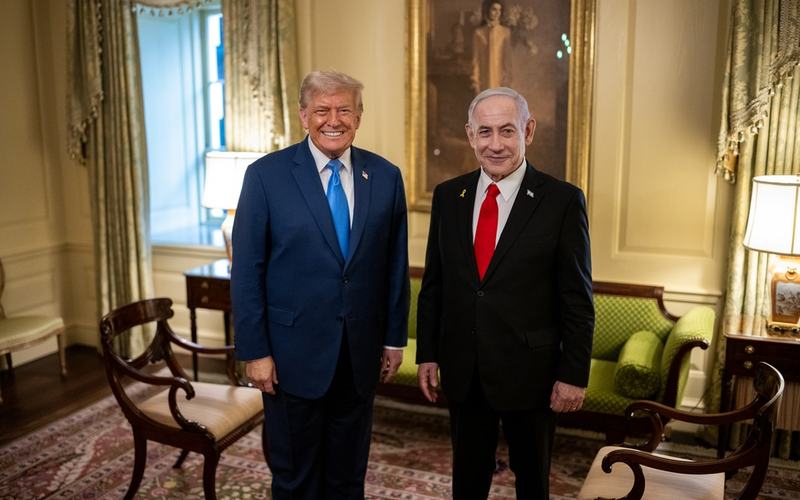
President Donald Trump urged Israeli Prime Minister Benjamin Netanyahu to advance the next phase of his Gaza peace initiative during a phone call Thursday, signaling that the administration wants to move forward regardless of the outcome of Israel's government formation process, according to an Axios report published Sunday.
The report further claims two sources familiar with the conversation said Trump wants to implement the roadmap despite uncertainty over whether Netanyahu or his political opposition will lead Israel's next government. The administration had largely held back from pushing the proposal during Israel's election campaign to avoid making Gaza a contentious political issue. Trump endorsed Netanyahu shortly before the Oct. 27 election, but is now seeking progress on the agreement.
The second phase of Trump's 20-point initiative calls for Hamas to disarm, the Gaza Strip to be demilitarized, and a new Palestinian technocratic administration to assume responsibility for governing the territory. The plan also envisions an international stabilization force to help secure the area.
The initiative began with a ceasefire agreement between Israel and Hamas approximately a year ago. Its first phase secured the release of the final 20 living hostages taken during Hamas's Oct. 7, 2023, terrorist attacks on Israel. However, negotiations over the next phase have remained stalled, largely because of disagreements over Hamas's future and Israel's security concerns.
Trump's Board of Peace has spent months developing a framework for the proposed transition. In July, the board reached an agreement with Hamas on a 15-point proposal intended to disarm armed groups and transfer civilian and security responsibilities to the proposed Palestinian government. Netanyahu's government has resisted moving forward, questioning whether Hamas would honor its commitments and warning that the terrorist organization is rebuilding its military capabilities.
During an August visit to Israel, Trump adviser Jared Kushner told Netanyahu that Hamas had agreed for the first time to disarm. Kushner encouraged the prime minister to take steps to determine whether the commitment was genuine. Since then, the Board of Peace has worked with Israeli government and military officials to refine the proposal and address concerns over how disarmament would be verified.
A U.S. official said implementation would take place gradually, with reconstruction beginning only after verified progress toward disarming Hamas. In September, the Board of Peace presented a six-month, $2.45 billion initial recovery plan for Gaza at the United Nations General Assembly. The proposal includes 66 projects focused on reconstruction and establishing a new governing structure.
The administration believes the proposal remains the best available path forward, but implementation will require cooperation from both Israel and Hamas. A source familiar with the discussions said the Trump administration, the Board of Peace and Israel agree there is no credible alternative to the current initiative.
Secretary of State Marco Rubio, Kushner and U.S. special envoy Steve Witkoff also participated in Thursday's phone call, which Netanyahu initiated. A source described the discussion as constructive and said the participants also addressed the war in Iran.
Former British Prime Minister Tony Blair, who serves on the Board of Peace, visited Israel on Friday and met with Netanyahu and opposition leader Gadi Eisenkot, who has been tasked with forming a new government. A source familiar with Blair's visit said he urged both Netanyahu and other Israeli political leaders to support the Gaza initiative.
A U.S. official acknowledged that implementing the proposal would be difficult but argued that it offered a path forward for Israel. The official emphasized that progress would depend on cooperation and a full partnership with the Israeli government.

Comments
No comments yet. Be the first to share your thoughts.