
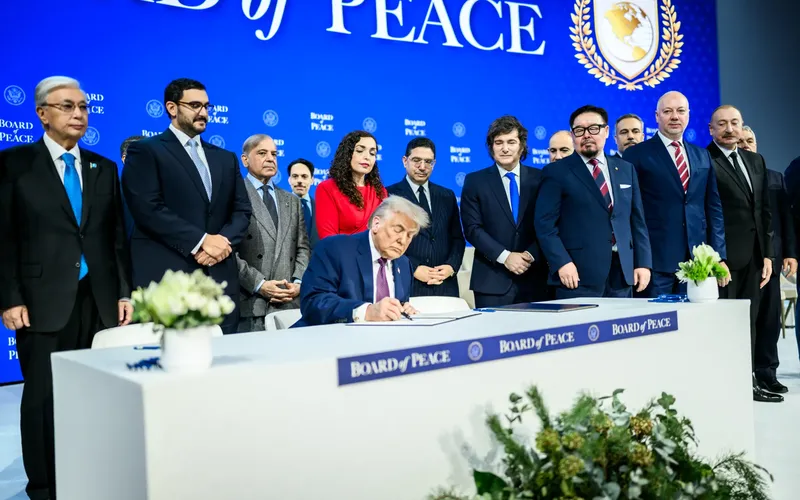
President Trump's Board of Peace unveiled a $2.45 billion, six-month recovery plan for Gaza on Wednesday during a meeting of its members.
The 66-project proposal focuses on immediate needs including temporary housing, rubble removal, hospital repairs, economic initiatives, and deployment of a multinational security force. Infrastructure accounts for roughly $1 billion of the total, with $400 million allocated for shelters, $275 million for clearing debris and unexploded ordnance, $50 million for hospital rehabilitation, and $30 million for road repairs.
Security-related efforts make up about $885 million, covering bases for an International Stabilization Force, recruitment and training of Palestinian police, and programs to buy back weapons as part of disarmament efforts. The plan also includes restoring electricity and water systems, border crossing repairs, and deployment of portable solar power kits.
The initiative stems from a year of work by the 28-country board and Palestinian technocratic officials. It forms the first phase of a larger effort to address an estimated $35.2 billion in physical damage across Gaza, with full reconstruction projected to require $71.4 billion over the next decade.
The board has secured commitments exceeding $18 billion from donors and private sources for the broader effort, though the initial $2.45 billion phase is not yet fully funded. Officials expressed confidence that political progress will unlock additional resources.
This plan supports the Trump administration's ceasefire framework, which includes phased Israeli withdrawals, Hamas disarmament, and establishment of new governance structures under the board's oversight. More than 25 countries and 75 organizations are expected to participate through contributions and implementation.
The announcement comes amid ongoing challenges to full implementation of the ceasefire, including Israeli military positions in parts of Gaza and the need for buy-in from all parties. The board's approach emphasizes sequenced, costed projects rather than vague promises, positioning it as a practical step toward stability in the region.

Comments
No comments yet. Be the first to share your thoughts.