
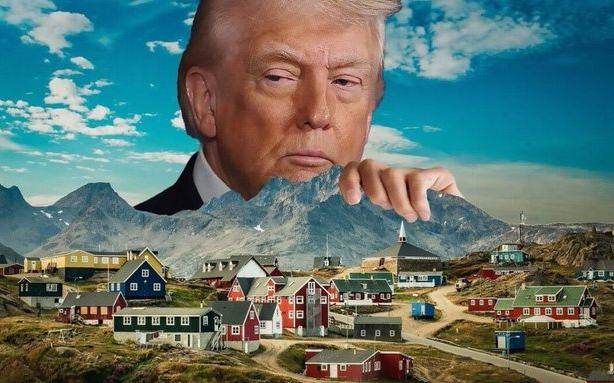
President Donald Trump signed a security agreement with Denmark and Greenland on Tuesday that grants the United States permanent rights to expand its military presence on the Arctic island, bars non-NATO adversaries from establishing bases or making sensitive investments, and comes at no direct cost to American taxpayers.
The deal amends the 1951 defense agreement and has no expiration date. It allows the United States to modernize and expand operations at the existing Pituffik Space Base, establish new defense areas at Narsarsuaq in the south and Mestersvig in the east, and seek additional facilities in the future. U.S. forces gain free access to air, land, sea, and undersea routes across Greenland. Non-NATO countries are prohibited from setting up manned or unmanned military installations or maintaining a persistent military presence without the unanimous consent of the United States, Denmark, and Greenland. The agreement also creates a screening mechanism for sensitive investments in sectors such as critical minerals, ports, and telecommunications, aimed at blocking Chinese and Russian influence.
Trump described the outcome in clear terms before and after the signing. He said the United States would have “permanent control over security and all other needs” on the territory, the complete ability to defend the American continent, and that “no U.S. adversary will ever be permitted to establish a military presence in Greenland anymore, or make sensitive investments there without our express written approval.” He also pledged two “very major” bases. The text delivers on those points: permanent basing and access rights, an explicit adversary ban, investment screening, and the two designated new defense areas, all while preserving Danish sovereignty and Greenland’s right to self-determination.
The agreement follows months of aggressive public pressure from Trump, who had repeatedly floated acquiring Greenland outright and refused to rule out stronger measures. That opening demand drew sharp criticism and predictions that no meaningful deal was possible. Instead, the maximalist approach produced expanded, permanent U.S. military authority that officials say would not have been on the table without the initial hard posture, a classic example of the negotiating style Trump has long described as the art of the deal.
Democrats and some European voices continue to argue the outcome falls short of full territorial control. In reality, the text locks in the exact security objectives Trump identified from the start. What critics dismissed as an impossible demand produced a permanent U.S. veto over adversary presence and investment, new bases, and unrestricted access, results that were never offered before the pressure campaign began. Reasonable observers see a clear win; the alternative reading requires ignoring the plain language of the agreement.
Secretary of State Marco Rubio called the result a deal that “permanently and completely addresses our national security concerns in Greenland.”

Comments
No comments yet. Be the first to share your thoughts.