
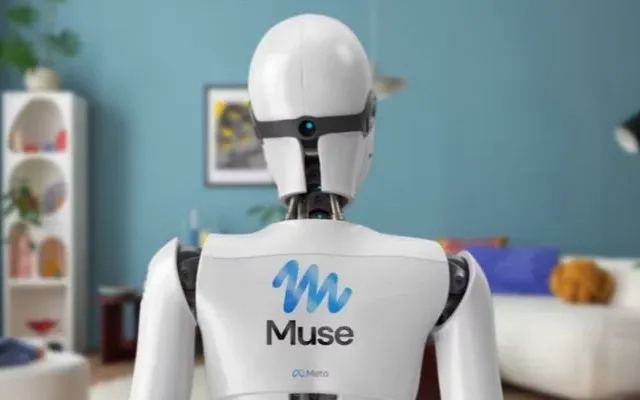
Meta Platforms has developed a working humanoid robot in partnership with Chinese robotics startup Fourier and is already building a second version as the technology giant expands its ambitions beyond social media and into consumer robotics.
The first prototype, internally named Max, was reportedly developed in approximately three months through close collaboration between Meta's robotics team and Fourier, a Shanghai-based company specializing in humanoid and service robots. The machine stands approximately five feet tall and weighs around 106 pounds.
According to people familiar with the project, Meta employees traveled to China to work directly with Fourier's engineers. Li-Chen Miller, Meta's vice president of product for robotics, reportedly spent nearly two months at the company's Shanghai factory helping oversee development. Max was subsequently demonstrated to Meta employees during an internal robotics summit in late August.
The prototype features a display capable of mimicking human facial expressions, two built-in speakers, and five-fingered hands designed to pick up smaller objects such as bottles and toys. It is powered by Nvidia's Jetson Thor chip and uses a separate software platform to control its movements.
Meta also established specific requirements for how the robot should interact with people inside a home. Those capabilities include recognizing a person's voice from approximately 16 feet away, interpreting hand gestures from roughly 10 feet away, maintaining eye contact, and communicating different operating states through facial expressions. The robot is designed to signal when it is listening, thinking, speaking or uncertain.
The company began developing a second prototype, known as Max 2, in September. The updated version is expected to feature a redesigned torso, improved hands with more advanced object-manipulation capabilities, a projector for displaying visual information, and additional sensors intended to help the machine navigate stairs.
Meta's broader objective is to develop humanoid robots capable of assisting with everyday household activities. Company leadership has reportedly viewed the machines as a potential physical extension of its Muse Super Intelligence agent, allowing digital capabilities to interact with the physical world and perform tasks around the home.
The robotics initiative has become a growing priority for Meta Chief Technology Officer Andrew Bosworth, who has taken a more direct role in overseeing the division following a leadership change. Former Cruise CEO Marc Whitten, who joined Meta to lead its robotics efforts, departed the company in August. Ning Li subsequently became interim leader of Meta Robotics Studio.
Meta has also strengthened its robotics research through acquisitions. In May, the company purchased Assured Robot Intelligence, a startup developing software designed to help robots understand human behavior and adapt to different environments. The acquisition added further expertise as Meta works to develop machines capable of operating in homes and interacting naturally with people.
However, the partnership with Fourier comes with potential complications. The Trump administration has increased scrutiny of China's dominance in the robotics industry, particularly over concerns involving supply chains, cybersecurity, and American dependence on Chinese-manufactured technology.
In July, the Federal Communications Commission restricted imports of certain new Chinese humanoid robot models, citing national security concerns. Existing exemptions allow limited quantities to be imported for research and development, although the FCC has considered tightening those restrictions further. Such measures could complicate Meta's ability to obtain Chinese hardware and components as it moves from prototypes toward larger-scale development.
A Meta spokesperson said the company's work with Fourier is focused on internal research and experimentation and that it has no plans to sell the current prototype units.
The company would also face considerable competition if it eventually decides to enter the consumer humanoid robot market. Tesla is developing its Optimus robot, while companies such as Figure and 1X Technologies are pursuing machines designed to perform physical tasks in homes and workplaces. Chinese manufacturers have also been rapidly expanding their production capabilities.
Meta has not announced a commercial release date or confirmed that it intends to manufacture humanoid robots for consumers. For now, the development of Max and its successor represents an experimental effort to determine how humanoid machines could eventually bring Super Intelligence technology into everyday household activities.

Comments
No comments yet. Be the first to share your thoughts.