
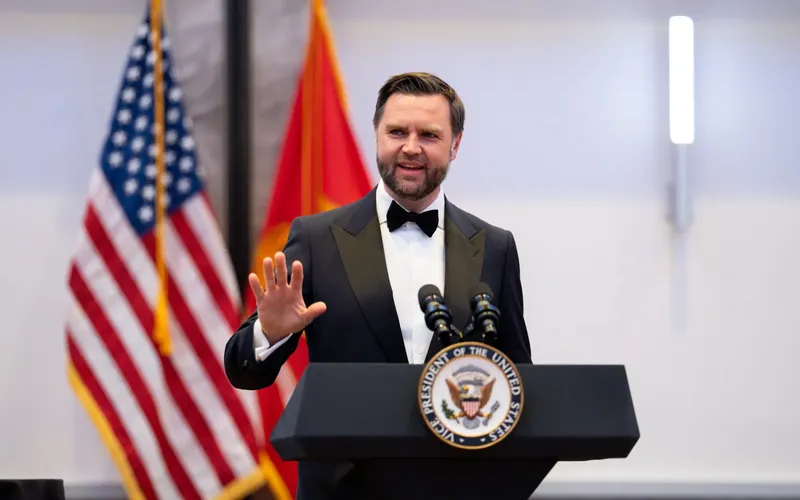
Vice President JD Vance said Wednesday that Nvidia CEO Jensen Huang does not need a presidential pardon, pushing back on speculation about potential criminal allegations against the technology executive as he prepares to face congressional scrutiny over national security concerns.
“I don't think Jensen needs a pardon at all. I haven't seen any evidence, again, that he committed a crime,” Vance told reporters after serving Thanksgiving dinner to military personnel at Wright-Patterson Air Force Base in Ohio.
The vice president said any evidence of criminal wrongdoing should be handled by the appropriate law enforcement authorities rather than through public speculation.
“And if there is evidence that he committed a crime, then that's up to relevant authorities to actually bring a prosecution against him,” Vance said.
JD Vance on Jensen Huang:
— Clash Report (@clashreport) November 25, 2026
I don't think Jensen needs a pardon at all. I haven't seen any evidence, again, that he committed a crime.
And if there is evidence that he committed a crime, then that's up to relevant authorities to actually bring a prosecution against him. pic.twitter.com/jqC4h0atSk
Vance also said he had received assurances from the Justice Department and multiple officials within the national security apparatus that Huang was not under investigation. He identified Attorney General Todd Blanche as one of the officials with whom he had spoken.
The comments came after President Donald Trump told the New York Post that a pardon for Huang was “always an option,” although he did not believe one would be necessary. Trump also said he wanted Huang to answer questions truthfully when he appears before congressional lawmakers.
Huang’s position at Nvidia became the subject of intense scrutiny earlier this month following reports that he had been targeted by a foreign intelligence operation. The company’s board announced an independent investigation after reporting raised concerns about Huang’s personal relationships, including an affair with a woman suspected by U.S. officials of having ties to Chinese intelligence.
Huang acknowledged making serious mistakes in his personal life and said he regretted creating problems for Nvidia’s board. He also pledged to cooperate with the company’s independent review.
The Nvidia board initially removed Huang from his leadership position, but reinstated him 11 days later following pressure from Trump and discussions with senior administration officials. Trump has said he personally urged the board to bring Huang back, arguing that his leadership was important to the company and America’s technological competitiveness.
Vance defended the administration’s involvement, saying the accusations against Huang were based on anonymously sourced reporting rather than evidence of criminal conduct. He also emphasized Nvidia’s importance to U.S. efforts to maintain an advantage over China in advanced semiconductor technology.
The vice president said the administration’s primary concern was ensuring that Nvidia’s advanced chips do not reach unauthorized recipients or undermine American export controls.
Huang is scheduled to participate in a closed-door interview with House committees on December 1 and appear at a public Senate Banking Committee hearing on December 3. Lawmakers are expected to question him about national security concerns, the company’s oversight practices, and the circumstances surrounding his return to the CEO position.
Vance said the matter should be addressed through evidence and the appropriate legal process, rather than assumptions about whether Huang might eventually face prosecution.

Comments
No comments yet. Be the first to share your thoughts.